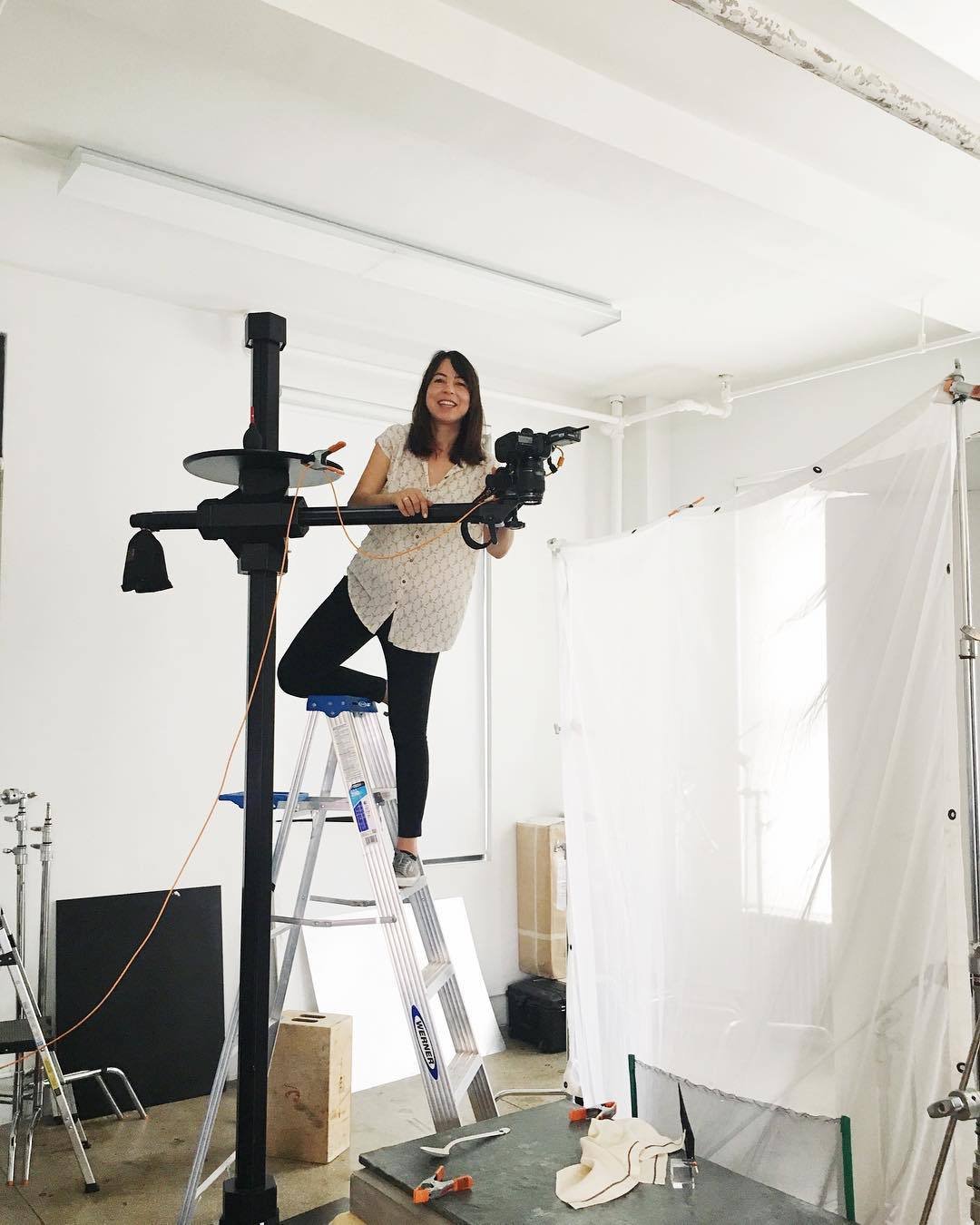
How did being raised, as you put it, “with two wood stoves, a generator…and a long dirt road” influence your interests, and eventual foray into photography?
In the community where I grew up, there were many artists—painters, writers and poets—kind of a hippie community. There were many talented artists, too. The arts were always encouraged. When I was little, I said I wanted to be an artist when I grow up. What 2nd grader normally says that? Also in my work, I’m always drawn to organic matter, like fruits, vegetables and plants. Where I grew up, we had a garden, we had a creek, and it was always inspiring to walk around in the forest and see mushrooms and pine trees—things like that.
Has San Francisco been a convenient location out of which you base your business? What inspired the move to this city?
Technically, I live in Oakland, which is near San Francisco. I went to school at Brown University and I lived on the east coast for four years, but I’m just a California person. I feel like I need to be in a place that is beautiful and inspiring. I mean, New York would make more sense, because I do photography, but San Francisco is a beautiful place to live. We have a huge garden and we have tons of fruit trees. I’m eating a fig from our tree right now. Originally, my boyfriend at the time, who is now my husband, went to UC Berkeley, so the real reason I moved to the area was because he was here.
Are most of your commissioned assignments located in California/the surrounding areas, or do you travel often?
I would say that ¾ of my commissioned work comes from clients in New York, but I do shoot a lot in this area. Clients know I’m out here, though, so they’ll send me stories. There aren’t a ton of editorial clients in this area, so I do travel quite a bit. My husband is a film director so he travels internationally a lot, so I’ll go with him and I’ll end up shooting a story.
Do you continue to do a lot of your own food/prop styling as you did with Dwell Magazine, or do you often receive help from a stylist?
It depends. I think part of the reason people hire me is because I’m very involved with the styling, so sometimes the client won’t send a stylist to work with me or hire one locally, but know that I can go into a restaurant and create a still life for them that they’re going to like. I would say that 50% of the time I’m completely on my own with just a couple of assistants, and for shoots that are a little more controlled, there’s more of a crew. When I did a food shoot for Oprah Magazine, and it was a feature story, so in that case we had a food stylist, a prop stylist, assistants to the stylists,.. so it just depends. I have a few stylists that I love working with, but being a photographer, clients are hiring me for my eye, my taste and my style, so I have a pretty strong vision of what I like. All of my still work that I do for my personal projects, I do it on my own. I don’t have a stylist.
Many of your photos contain a clean, minimalist aesthetic. Does this root from your Japanese upbringing, or is it purely coincidental?
[laughs] I actually do think that there’s some relationship. I do tend to like things uncluttered. Often times what I’ll do is take a lot of stuff out of the picture—you know, just making it easier to understand visually. Growing up in the house I grew up in, all of our furniture was built-in, and a lot of our stuff was picked up and put behind doors, so there were a lot of clean lines. We couldn’t just throw our stuff on the floor; everything had to be put away. So, I think there definitely is some relationship between that sort of minimal space and my aesthetic.
How did you begin your career in the photo industry? Were there any particular jobs that helped you in your success?
Originally I was more intent on approaching photography from the fine art world. I had been hired after graduation from Brown to be a curatorial assistant at a non-profit organization in San Francisco. Over the summer after I graduated, after 35 years, they went out of business. It was really disappointing and traumatic for me since I was excited about my first real job. But it’s almost like it was a blessing in disguise because I began looking for internships and I interned at Dwell magazine, working there for maybe four weeks before being hired. It was in the early years of Dwell and they were much smaller and pretty understaffed, so they hired me for a full-time position and I ended up working there for four years.
As far as me being a photographer now, that was really critical. First of all, I saw a lot of photography that was out there. I never understood how anyone could make a living as a photographer, or that it was even possible, but as I worked as a photo editor, I saw all of these people sending in their promotional materials and their websites. Some of it was great, and some of it wasn’t, and I couldn’t believe that some of these people were doing so well and their photography was not very interesting. So it was actually, in a funny way, very motivating. I felt that there was an opportunity for me. It was a great way for me to learn about different agents in New York and the west coast, how people put their work and portfolios together, their websites, what kinds of promos people create and how they send them in, what invoices looked like,..
When I quit, I made a spreadsheet of all the magazines I wanted to work for, because the whole time I had been shooting on my own. Even for those four years I was doing my own projects, and the reason that I quit is that it was getting overwhelming to do freelance work and be a photo editor, working 7 days a week. It was just too much, and I wasn’t giving my full attention to either. I felt like I was really slacking at my job, so I quit Dwell, but I had reached out to other photo editors, and because of my connections with Dwell they didn’t write me off as a random young person, but I had some kind of credibility. So I made a spreadsheet, went to New York and I scheduled appointments with all of the people I wanted to shoot for. That’s how I got a lot of my first clients.
Do you feel that it is important to continue working on personal photo projects as well as commissioned work, and why?
Yes, it is so important and it’s always one of those things I’m not doing enough of, but absolutely. With personal work, there’s a concept, or some sort of problem or idea I’m working on, and I feel like the meaning of a project can feel deeper. Commissioned work looks like your work formally, but there’s no idea more than making something look pretty. Personal projects can be really inspiring to clients, and they see it’s what you’re doing without having anyone telling you to do anything, so they know it’s coming from your heart. Honestly, most people refer to the work that I have done for myself. They’re not looking at the work that I shot for Oprah Magazine, but work that I did for my personal projects. My husband is a film director who directs TV commercials. He will often do short films with his own ideas, and those are always the ones that the clients are drawn to.
In what ways do you self-promote in order to “stay afloat” in the industry (i.e. mailing lists, source books, etc.)?
I used to send out emails and postcards, but I haven’t been doing that very much. And no one has asked for a portfolio lately; it’s pretty rare. So my portfolio is pretty outdated. People still love looking at them, but they don’t call them in the way they used to. The website is critical because it’s your face to the world. It’s an easy way for editors and art directors to look at your work. At the end of the year I’ll send a big present to my clients. Last year I sent them all a book and a personalized note. My email list is very customized to who I want to work for. I don’t send out thousands of emails, but around 300. I think it’s important to know who you want to shoot for and go for that. I wouldn’t send my photos to a car company, or something.
Also, I didn’t intend for it to be this way, but a lot of photo editors follow my Instagram feed. That’s been a funny type of marketing. At first I was trying to keep it as more of a pure thing; I didn’t intend for it to be a marketing tool. I don’t have a Tumblr account, but I know a lot of photographers who do—and blogs. Those are really good ways to show your work.
What do you feel is the most important thing that photographer should remember in reference to his or her own business plan?
I guess I’ve always charged somewhat high rates. I always feel like you can charge what you feel is fair to yourself and to the clients, but not to undercharge. Even though I’ve been shooting now on my own for six years, I feel like I knew my standard rate when I began because I’d been working a lot with photographers, so I didn’t start out very low. People will pay for it. You don’t want to undersell yourself. I also think it’s really important to have a clear understanding between the client and yourself about what the budget is. Occasionally a magazine will come to me and they’ll say they only have 800 dollars for the whole thing, and if I say yes I know those are the terms. I think it’s nice to be very straightforward from the get-go for your project with the clients, so you need to itemize your estimate with your fee and your equipment and your assistant, so they have a very clear understanding.
What are the benefits to being represented by a photo rep? Would you say that there are any negative aspects?
Advertising jobs are much more lucrative, though they aren’t always as creative. I’m hoping to have a family at some point, so I want to have a little more time so I feel that if I do more advertising I can make more money without working as much. A lot of things that an agent can do, I was able to do myself just because I had a lot of connections with Dwell. But agents can get you much more advertising than you can get on your own. A lot of time larger companies would rather talk to your rep when discussing budgets. I think they feel less comfortable when talking directly to photographers. There’s a level of professionalism that a rep can give you.
Which of your works are you most proud of, and why?
I’m most into the food still lifes that I do, and trying to capture quirky moments that I can’t always control but recognize and photograph. I’m more excited about them, so I feel more proud of them. My portraits are okay, but I’m a person that likes to shoot composed still lifes, including the ones done during travel.
What was your first editorial assignment?
I think it was for Dwell. I went up to Portland to shoot a picture of this paint company. I was really excited when I first got a job with Real Simple, though. I had worked with them before, but when I was on my own they also hired me to shoot some things. I think I did a shoot about chocolate. It was really terrifying, but I flew to New York and did the whole studio thing. It was overwhelming. I was still shooting film—Hasselblad—but it was very fun. We ate lots of chocolate.
Do you believe that it is important to enter photo contests in order to gain exposure?
PDN is a good magazine. I don’t really enter that many contests but I have entered some and I’ve been selected a few times. That’s a really helpful thing. There’s Hey Hot Shot, which is also a good one. It’s a great thing to put your work out there—more than anything, because you want the judges to see your work. Even if you don’t get selected, you want Kathy Ryan of the New York Times magazine just looking at your work and knowing that you’re out there.
Who (artist or non-artist) has been the biggest influence on your work, and why?
I guess I’d have to say Martin Parr, just because I love his sense of humor. I love him because he’s so funny with his photography, and I think there’s something about that quirkiness that I try to emulate a little bit. It brings a levity and I think it’s also more interesting—you know, like anyone can take a photo of a chocolate cake with caramel drips—well not anyone, but lots of people can do that. He just reminds me of celebrating the ugly stuff, too. And then there’s Irving Penn, with his still lifes, which are amazing.
Which camera and lens do you most often carry around with you?
I most often use a Canon 5D mark iii and a 24-70 lens.